
Ethanol PKPD
Ethanol has complex pharmacokinetics (PK; Holford 1987) and pharmacodynamics (PD; Holford 1997).
Pharmacokinetics
Ethanol PK is complex because of capacity limited elimination (aka Michaelis-Menten or saturable kinetics). This is associated with marked absorption rate dependent bioavailability.
Pharmacodynamics
Ethanol PD is complex because of the rapid development of tolerance and delays in effect which may differ depending on the biomarker.
Exploring ethanol
PKPD with simulation
Evaluation of
drinking guidelines
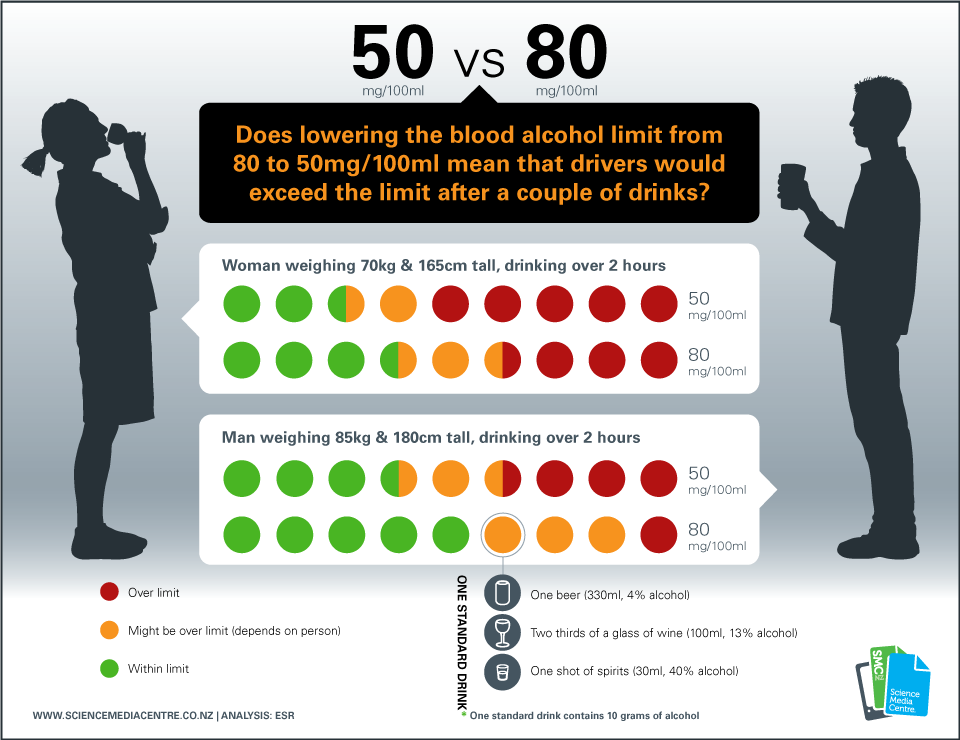
Simulation may be used to evaluate public web based guidelines which advise on the number of standard ethanol drinks which are likely to keep blood ethanol concentrations below the legal driving limit and how to calculate blood alcohol concentration.
.
Drink me! Excel
simulation of Ethanol PK
Excel macros must be enabled to run the clinical pharmacologist simulation model.
The idea for the DrinkMe
worksheet came from an
anonymous workbook developed by a financial analyst. The financial
analyst
model assumes the dose is instantaneously and completely absorbed one
hour
after the nominal time of the drink. It is then eliminated by an
approximate
first-order process. The Excel workbook (drink plan.xls) on which this
worksheet is based has been found at Beer
Beer Beer and Brisbane
The clinical pharmacologist model is described in more detail on the
Science
worksheet. The graph on the DrinkMe
worksheet
compares the financial analyst model (calculated on the DrinkMe
Worksheet using Excel formulae) with the well stirred mixed-order
elimination
model (calculated on the Science worksheet by solving a set of
simultaneous
differential equations).
The tactical chunder is
implemented as an immediate
loss from the gut. The ethanol amount lost is constrained not to be
more than
the amount remaining to be absorbed.
The clinical pharmacologist pharmacokinetic model is based on
first-order
absorption with no lagtime
and elimination by a combination
of mixed order (MO) and first order (FO) pathways. A simple MO model
assumes
ethanol is absorbed into a single distribution and elimination volume.
The more
complex WS model assumes ethanol undergoes absorption rate dependent
first pass
metabolism in a well stirred liver compartment. The WS model depends on
portal
liver blood flow (Q). The instantaneous bioavailability (Fws)
assumes complete absorption from the gut into the portal vein. The
solutions to
the two models for the mixed order pathway are shown on the Science
worksheet.
The model is defined using a system of differential equations and
solved using
a variable step size Runge-Kutta
4/5 Order algorithm
(Fehlberg 1969). The
code is based on Fortran
(Forsythe, Malcolm & Moler
1977) adapted for QuickBasic to provide a DE solver for MKMODEL
(Holford 1994).
The QuickBasic code was then ported to Visual Basic for Excel
simulation.
- Fehlberg E. Low-order classical Runge-Kutta
formulas with stepsize
control and their application to some heat transfer problems. NASA
Technical Report 1969;R-315
- Forsythe
GE, Malcolm MA, Moler
CB. Computer methods for mathematical computations. Englewood Cliffs:
Prentice-Hall,Inc; 1977
- Holford
NHG. MKMODEL, a quantitative modeling
system for pharmacologists. In. 5 ed. Cambridge, MA: Biosoft; 1994
- Holford
NHG. Clinical pharmacokinetics of ethanol. Clinical Pharmacokinetics
1987;13:273-292
- Holford NHG. Complex PK/PD models - an alcoholic experience. International Journal of Clinical Pharmacology and Therapeutics 1997;35(10):465-468